
Texas Health Plano Delivers for the Chakrabortys, Times Three
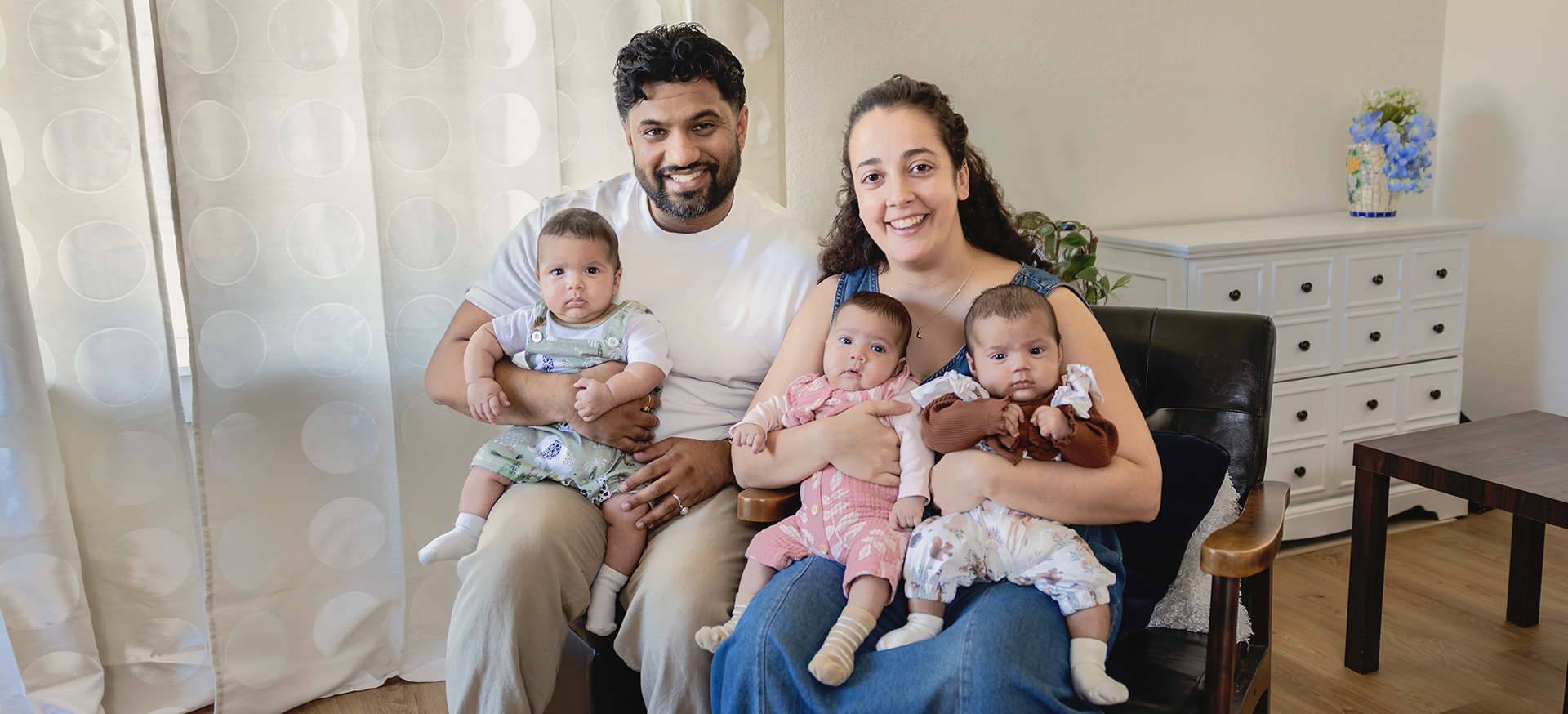
Noelia Chakraborty stayed pretty active throughout her pregnancy, even though she was carrying triplets. It wasn’t until about week 33 that her feet began to swell and she developed an annoying but harmless PUPPP rash on her belly.
“That was the most uncomfortable moment of my whole pregnancy,” Noelia jokes.
Being her first maternity experience and knowing the risks that might come with carrying multiples, the mom-to-be was thankful that she didn’t have to deal with any serious complications. She and her husband could focus on the arrival of their three little ones and Noelia’s planned cesarean delivery at 35 weeks.
About 60 percent of all multiple pregnancies occur before 37 weeks of gestation. The average gestation for a triplet pregnancy is even lower, at 32 weeks. Noelia considered herself very blessed to be healthy with a natural pregnancy and carrying her babies beyond 32 weeks. The American Society of Reproductive Medicine estimates that triplets occur in nearly 1 in every 8,000–10,000 pregnancies conceived without fertility assistance.
Beating the Odds
As planned, Noelia and her husband headed to Texas Health Presbyterian Hospital Plano on delivery day. Lilly, Luna, and Leon weren’t far behind in their arrival.
Although small, the three babies were fighters. Luna weighed just 3 lbs., 7 ounces; Lilly weighed 4 lbs., 10 ounces; and Leon was 5 lbs. To the Chakrabortys’ surprise, Lilly was well enough to go straight to the Mother/Baby Unit with Noelia. Luna and Leon needed some extra-special care in the hospital’s Level IV Neonatal Intensive Care Unit (NICU).
“I don’t really remember what happened right after the C-section, because it all happened very fast,” Noelia says. “But I do remember the team taking really good care of me heading to the Mother/Baby unit. I think once they finished with my stitches, they took me to my room and my husband and Lilly were waiting there.”
Noelia and her family settled in to a routine on the Mother/Baby Unit as much as possible, with help from the unit’s skilled staff. “Once they transferred us to the Mother/Baby Unit, we met with two nurses,” she adds. “I remember them being very helpful right away. We had tons of questions, and they took the time to explain next steps.
They explained to us how we should feed and care for Lilly. Whenever we had a doubt about something, they were quick to respond. The nurses also constantly observed the C-section cut and asked if I was in pain, and they helped me the day after to take a shower.”
Noelia wasn’t the only person to be pampered during the family’s hospital stay. The couple could easily order breakfast through the TV and Noelia’s husband was able to sleep soundly on a sofa in the room.
Not far away in the NICU, Baby Leon got the care he needed for some early trouble with feeding and breathing. The NICU staff fed him through a tube and he spent a day on oxygen before being able to breathe on his own. Just nine days later, he was ready to go home.
Being the smallest of the three newborns, Baby Luna needed a little extra time to develop and grow. When she was well enough, she was transferred to the NICU’s Family Center. There, a camera was set up so the Chakrabortys could observe their little girl when not nearby. After 12 days in the hospital, Luna was also ready to join her family.
“It was a very emotional moment taking Lilly home after three days and having to leave both Leon and Luna behind,” Noelia admits. “I know I cried quite a bit those first few days because I felt like I was abandoning them. One of the things that was so reassuring was the NICU team. During those first three days, I always spent a few hours in the NICU each day and I was taken aback by how well they cared for my babies.”
Hope, Gratitude, and Lots of Caring
The maternity journey doesn’t simply end when a baby is born, and the Chakrabortys are thankful the care they received went well beyond the delivery experience. The nurses were there to support Noelia through the initiation of breastfeeding, and a lactation specialist regularly helped the new mom with latching and pumping.
The nurses also showed the couple bottle-feeding techniques that wouldn’t overwhelm the babies. An occupational therapist on the medical staff even provided bottle recommendations for each unique baby.
“We realized quite quickly that all three of our babies had different characteristics and liked different things,” Noelia explains. “The NICU team was amazing in showing me things like: ‘Luna likes it when you hold her like this, or Leon likes it when you burp him like this.’ One of the other things we remember was that the doctor would call us every so often with an update on our babies’ progress. That was probably the biggest reassurance. We literally waited each day for that call.”
The Chakrabortys were so grateful for the care provided by so many that they left a handwritten card in the hospital when they left to recognize each staff member who made an impact.
“I was taken aback by the amount of love and care they provide all the babies. The idea that your baby was just born and might need to go to the NICU for whatever reason, is extremely frightening. After seeing the care that the teams put in, it really brought us so much hope. And every time one of the nurses shared with us how they felt about our baby, it brought tears to our eyes. They showed us so much. We are forever grateful to the whole NICU unit,” she says.
Preparing for a baby? Learn about maternity care at Texas Health.
What’s it like to raise triplets? Follow along with the Chakraborty Family on Instagram #a.trip.with.triplets.