
MANSFIELD, Texas — Patients undergoing treatment for alcohol and substance use disorders at The Addiction Recovery Center by Texas Health have a new tool to help them on their path to sobriety: virtual reality.
Usually associated with video games, the platform helps therapists at the Mansfield center provide a safe space for patients to practice returning to social environments — such as parties or family gatherings — while learning to manage addiction-related triggers, all under professional guidance.
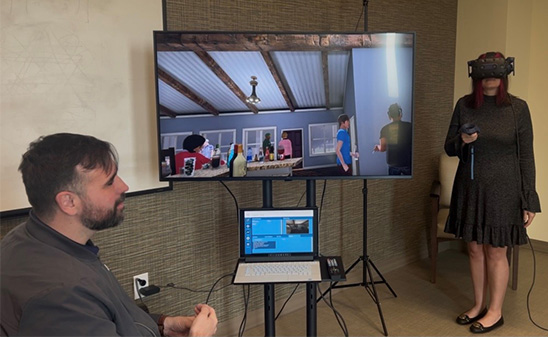
“Texas Health is pioneering the use of this innovative treatment approach in the Dallas-Fort Worth area, using immersive virtual reality to simulate real-world, high-risk environments for our patients in a controlled, safe setting,” said Ken Jones, Psy.D., LCSW-S, Behavioral Health clinical officer of Texas Health. “This technology enables therapists to actively engage with patients in the moment, helping them recognize their body’s physiological responses to triggers and apply coping strategies they’ve learned to make healthier choices.”
The equipment and system were purchased using funding provided by the Texas Health Resources Foundation.
“The Texas Health Resources Foundation is committed to advancing innovative solutions that make recovery more accessible and effective,” said Laura McWhorter, president of the Foundation. “We’re investing in a new dimension of healing that meets patients where they are and helps guide them toward lasting recovery.”
How it works
A patient wears a virtual reality headset while their experience in the simulated environment is displayed on a nearby screen, enabling the therapist to observe and monitor in real time.
“The platform is highly customizable — even down to a patient’s specific drug or drink of choice,” Jones said. “It also incorporates olfactory elements, introducing scents like synthetic marijuana, vodka or beer to enhance the immersive experience.”
When a patient starts showing physiological signs —like sweaty palms or a racing heart — while approaching a loud house party or being offered a drink or a drug, the therapist can guide them through the experience and recommend breathing techniques or grounding strategies to help them manage their response.
“Over time, we aim for patients to progress with greater confidence — showing fewer physiological reactions and demonstrating stronger coping skills,” Jones said.
The treatment is being used with patients in both residential and outpatient care, individually and as part of group therapy sessions. Therapists at the center are currently evaluating treatment outcomes to further refine and expand the treatment’s use as a supportive resource in addiction recovery.
How it’s helping
The treatment is typically introduced to patients midway through the recovery process, once patients have learned coping skills, Jones said. By then, patients often feel more confident, miss their families and are ready to return home.
“One of the most common reactions we’re seeing is patients realizing that they may not be as far along in their recovery as they believed,” Jones said. “It can be a powerful reality check when they discover how easily a virtual environment can trigger them. In fact, we’ve had a few patients who were planning to leave early choose to stay, recognizing they need more time to build resilience.”
The treatment has also helped some patients still struggling with the idea of sobriety as a future pathway.
“Some patients still feel they should be able to drink socially and aren’t ready to commit to complete abstinence,” Jones said. “But when they’re placed in a simulated environment, the experience can be surprisingly overwhelming. It can lead them to reevaluate whether social drinking or substance use is truly a safe or realistic option for them.”
The Addiction Recovery Center is certified by the American Society of Addiction Medicine and the Commission on Accreditation of Rehabilitation Facilities. If you or someone you know would like to schedule an assessment, please call 682-812-6150. After hours, the line is redirected to Texas Health’s Behavioral Health call center.
Related News
About Texas Health Resources
Texas Health Resources is a faith-based, nonprofit health system that cares for more patients in North Texas than any other provider. With a service area that consists of 16 counties and more than 8 million people, the system is committed to providing quality, coordinated care through its Texas Health Physicians Group and 29 hospital locations under the banners of Texas Health Presbyterian, Texas Health Arlington Memorial, Texas Health Harris Methodist and Texas Health Huguley. Texas Health access points and services, ranging from acute-care hospitals and trauma centers to outpatient facilities and home health and preventive services, provide the full continuum of care for all stages of life. The system has more than 4,400 licensed hospital beds, 6,400 physicians with active staff privileges and 30,000 employees. For more information about Texas Health, call 1-877-THR-WELL, or visit www.TexasHealth.org.