
FORT WORTH, Texas — Carlos Romero was driving his lawn care crew to their next location when sharp chest pains made him stop the truck. Suddenly, everything went black, and the 56-year-old passed out.
Romero’s co-worker and two bystanders called 911 and immediately began CPR. Arriving minutes later, paramedics shocked Romero six times with an automated external defibrillator. His pulse finally stabilized, and they transported him via ambulance to Texas Health Harris Methodist Hospital Fort Worth a Level 1 Trauma Center and Comprehensive Cardiac Center.
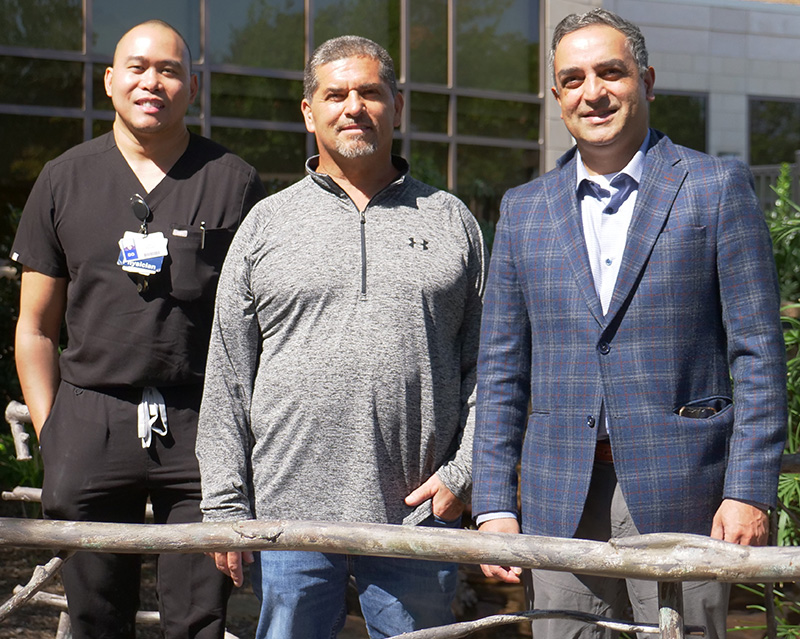
Carlos Romero with Doctors
Romero had suffered a massive heart attack and sudden cardiac arrest, which happens when the heart beats irregularly and doesn’t produce proper blood flow to vital organs, and can lead to death.
“Mr. Romero’s condition was extremely critical, and his heart had completely stopped beating,” said Jonathan Besas, D.O., a pulmonologist on the Texas Health Fort Worth medical staff. “When it comes to cardiac arrest, time is precious. Every minute without effective circulation leads to worsening heart and brain function.”
According to the National Institutes of Health, nearly 350,000 people a year experience an out-of-hospital cardiac arrest in the U.S., and just 10% of those patients survive.
“A couple weeks before everything happened, I felt a little chest pain, so, I took a short break,” said the 56-year-old. “After about 10 minutes, it went away, I brushed it off and got back to work. I had no idea what would happen later.”
Receiving high-quality, complex care
According to Besas, who serves as ECMO medical director at Texas Health Fort Worth, immediate intervention such as CPR, along with rapid coordination of advanced therapies, is crucial for survival and recovery. Upon arrival, Romero was placed on extracorporeal membrane oxygenation (ECMO), which allowed time for his heart and lungs to recover. The process takes place outside of the body using a machine to pump blood through an artificial lung back into the bloodstream of the patient.
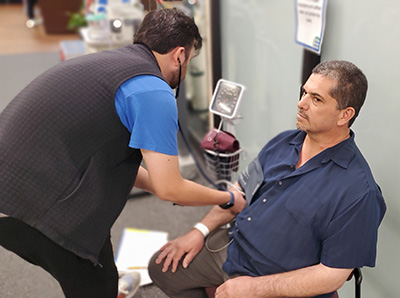
“The sooner Mr. Romero could be placed on ECMO, the greater the chances for restoring his circulation, preserving organ function and achieving a meaningful recovery.”
Tests determined Romero’s heart attack originated from two major arteries with extensive blockages. Sukesh Burjonroppa, M.D., an interventional cardiologist employed by Texas Health Physicians Group* who is on the Texas Health Fort Worth medical staff, performed an emergency catheterization and placed a stent in each artery to restore blood flow.
“While Mr. Romero was in the emergency room, he went into cardiac arrest again,” Burjonroppa said. “His condition was life-threatening. To prevent further deterioration of his heart, the care team determined along with ECMO, adding a mechanical pump — one of the world’s smallest heart pumps — would help rest his heart muscle, improve his heart function, and help save his life.”
Thriving after near-death experience
After four days of ECMO therapy, six days on a mechanical heart pump and several days of inpatient rehabilitation, Romero returned home, grateful to celebrate 38 years of marriage with his wife, Sherri. The couple look forward to many more anniversaries and appreciate the wonderful support from everyone, from housekeeping staff to physicians on the medical staff to the nurses at Texas Health Fort Worth.
“Sarah McFarland, one of his ICU nurses, prayed with us and even came to check on Carlos on her day off. That was so helpful and a pleasant surprise,” Sherri Romero said. “Everything lined up perfectly. The power of prayer and advanced technology worked hand in hand to save his life.”
Besas said it’s rewarding to treat the sickest patients in the community.
“Mr. Romero’s remarkable recovery is a testament to the collaboration and dedication of Texas Health Fort Worth’s multidisciplinary team using technology to the fullest as we care for our patients.”
Burjonroppa agrees.
“To witness someone in the throes of a catastrophic event recover and go back to enjoying life — very few things in medicine are more rewarding than that.”
*Physicians employed by Texas Health Physicians Group practice independently and are not employees or agents of Texas Health Resources hospitals.
Related News
About Texas Health Resources
Texas Health Resources is a faith-based, nonprofit health system that cares for more patients in North Texas than any other provider. With a service area that consists of 16 counties and more than 8 million people, the system is committed to providing quality, coordinated care through its Texas Health Physicians Group and 29 hospital locations under the banners of Texas Health Presbyterian, Texas Health Arlington Memorial, Texas Health Harris Methodist and Texas Health Huguley. Texas Health access points and services, ranging from acute-care hospitals and trauma centers to outpatient facilities and home health and preventive services, provide the full continuum of care for all stages of life. The system has more than 4,400 licensed hospital beds, 6,400 physicians with active staff privileges and 30,000 employees. For more information about Texas Health, call 1-877-THR-WELL, or visit www.TexasHealth.org.