
PLANO, Texas — As the founder of a local business, Jack Baum’s fast-paced routine kept him in constant motion. One day, mid-thought, Baum suffered a stroke, leaving him unable to speak. His two colleagues, sitting nearby immediately called 911.
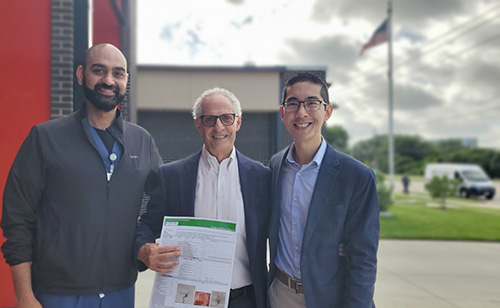
Paramedics took the 69-year-old to Texas Health Presbyterian Hospital Plano, one of fewer than 50 Comprehensive Stroke Facilities in the state. Over the course of two days, Baum received high-quality neurological care, including an emergency thrombectomy, which is a procedure used to remove blood clots from the brain.
Understanding stroke symptoms
“In the ambulance, I heard everything they were saying to me, but I couldn’t respond,” Baum said. “It was scary, frustrating, and I couldn’t do anything about it.”
Speech difficulty is among the stroke symptoms outlined using the B.E. F.A.S.T. acronym, along with balance, eyes, face, arms and time.
Stroke ranks as the No. 4 cause of death in Texas, and some of the highest rates of stroke prevalence are in North Texas.
“Time is brain, and for every minute without proper blood flow, nearly 2 million neurons die,” said Ryan Cheung, D.O., a neurohospitalist on the Texas Health Plano medical staff, who serves as the hospital’s Stroke Program medical director. “Mr. Baum is an elite athlete and an Iron Man competitor, but his journey highlights how rapid recognition of stroke, coordination of care and high-quality care at a Comprehensive Stroke Facility can produce excellent outcomes after a severe stroke.”
Receiving high-quality care
When Baum arrived at Texas Health Plano, he was taken immediately to the hybrid neurointerventional operating suite, where two X-ray machines create detailed, three-dimensional images of blood vessels in the brain. In Baum’s case, a clot was found on the left side of his brain.
“The technology offers clearer images of the brain and minimizes radiation exposure,” Cheung said. “Since it’s close to the Emergency Department, it helps stroke care teams locate and retrieve blood clots sooner.”
To prevent further damage and to restore blood flow to his brain, Ghasan Ahmad, M.D., a neurointerventional radiologist on the Texas Health Plano medical staff, performed the thrombectomy. Making a small incision in Baum’s upper thigh, Ahmad threaded a catheter and suction device through an artery to remove the clot, returning Baum’s blood flow to normal.
Baum returned home the next day.
Turning tragedy into triumph
“Mr. Baum’s story is remarkable in identifying the symptoms early helped the care team restore blood flow to his brain within one hour from when his stroke symptoms started,” Ahmad said.
Just four days after the stroke Baum was back running his Plano-based company and said: “Thanks to the great care I received, from the EMTs and nurses, to the physicians on the medical staff at Texas Health Plano, I walked out of the hospital with confidence and full of motivation.”
To learn more about Texas Health’s neuroscience services, click here.
* Doctors on the medical staffs practice independently and are not employees or agents of Texas Health hospitals or Texas Health Resources. © 2026 Texas Health Resources.
Related News
About Texas Health Resources
Texas Health Resources is a faith-based, nonprofit health system that cares for more patients in North Texas than any other provider. With a service area that consists of 16 counties and more than 8 million people, the system is committed to providing quality, coordinated care through its Texas Health Physicians Group and 29 hospital locations under the banners of Texas Health Presbyterian, Texas Health Arlington Memorial, Texas Health Harris Methodist and Texas Health Huguley. Texas Health access points and services, ranging from acute-care hospitals and trauma centers to outpatient facilities and home health and preventive services, provide the full continuum of care for all stages of life. The system has more than 4,400 licensed hospital beds, 6,400 physicians with active staff privileges and 30,000 employees. For more information about Texas Health, call 1-877-THR-WELL, or visit www.TexasHealth.org.