
Request for Proposals
Proposals Accepted: April 13 – May 29, 2026
Texas Health Community Impact requests proposals to fund local organizations collaborating on innovative solutions that address barriers to community health and wellbeing. Up to $5 million is available across nine counties for the 2027-2028 grant cycle.
These community health improvement grants are made possible by Texas Health Resources—a faith‑based, nonprofit health system that cares for more patients in North Texas than any other provider.

Applications must fulfill four key requirements: 1. Propose an innovative approach. 2. Demonstrate a collaborative effort between two or more organizations. 3. Align with strategic priorities. 4. Promote sustainability.
Read Grant Key Requirements.
To learn about proposal planning and other Texas Health Community Impact grant essentials, watch sessions from our Innovation Workshop.
-
Public Health Innovation
As described by the Public Health Accreditation Board, public health innovation refers to the creation and implementation of a novel process, policy, product, program, or system leading to improvements that impact health and equity.
Tenets of public health innovation include the following:
- It is an ongoing, systematic process that can generate incremental or radical change.
- It requires both collaboration and co-production with people who have lived experience and will be affected by the results of the innovation.
- It is an open process lending itself to adaptation or replication.
The graphic below illustrates Texas Health Community Impact’s innovation scale, which is used to score grant applications.

-
Collaboration
Collaboration means working together to address systemic problems with the community at the center. According to the National Network for Collaboration, approaches that “bring individuals, agencies, organizations, and community members” together to generate solutions for current and emerging problems collectively are at the core of collaboration.
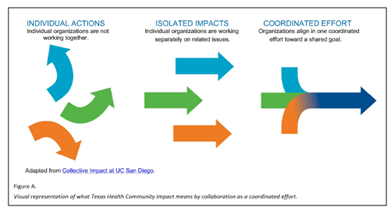
Collaborative approaches integrate service offerings, building meaningful connections between agencies to eliminate gaps in community services. In Figure A below, collaboration involves multiple organizations aligning efforts and working collectively toward a shared goal.
Each collaboration must designate a lead organization that will:
- Submit the proposal on behalf of the collaboration
- Coordinate project activities
- Manage the budget and finances
- Oversee reporting
- Serve as the primary point of contact with Texas Health
Lead agencies are strongly encouraged to collaborate with organizations that possess strong local ties to the community.
-
Strategic Alignment
Applicants are expected to detail how the proposed project adequately responds to the strategic priorities identified in the region and fulfills the requirement to serve the target ZIP code areas.
Proposed projects should:
- Focus on reducing the negative impact of non-medical drivers of health.
- Incorporate innovative solutions to improve health outcomes.
- Have a solid implementation plan that considers cultural sensitivities and addresses community needs.
- Clearly demonstrate the level of involvement and contributions from collaborators, including deliverables and budgetary commitments.
- Identify opportunities for Texas Health to engage, for example through volunteering or education.
-
Promote Sustainability
Texas Health also contributes to sustainable practices by ensuring applicants clearly understand the evaluation requirements, offering personalized technical assistance and supporting the efforts of our third-party evaluation in strengthening data collection and reporting.
By adhering to these standardized requirements, applicants can strengthen their proposals by reflecting the core values that drive Texas Health Community Impact. Our shared commitment to addressing non-medical drivers of health, fostering meaningful partnerships and promoting sustainability will help create lasting improvements in the communities we serve. Together, we can advance health outcomes and build a foundation for impactful, data-driven solutions that endure beyond the grant cycle.
-
Expectations of Award Recipients
Fulfill Memorandum of Understanding (MOU) Requirements.
Lead applicants of awarded collaboratives and Texas Health will execute an MOU detailing the following:
- Project Goals, Deliverables and Outcomes
- Data Sharing Agreement
- Payment Terms
- Reporting Requirements
- Terms and Conditions
- Texas Health Brand Use Agreement
Engage with Texas Health Community Impact.
Lead applicants and respective collaborators should engage with Texas Health in the following ways:
- Receiving technical assistance from the Texas Health Program Manager—including but not limited to regular touch base calls (and as needed), guidance on budget changes or project adjustments, and connections to enhance outcomes.
- Fulfilling communication requirements.
- Participating in learning opportunities either convened or facilitated by Texas Health.
- Hosting at least one site visit to highlight progress to key stakeholders associated with Texas Health.
- Presenting the collaborative approach and/or results at meetings convened by or with Texas Health.
-
Eligibility
Project Implementation.
Applicants must demonstrate the ability to begin implementing activities within four months of the execution of the MOU. Exceptions may be considered on a case-by-case basis.
Prior Applicants.
Organizations that applied for a previous Texas Health Community Impact grant cycle and were not awarded are eligible to apply.
Not Eligible.
Organizations previously funded as lead agency for two cycles are not eligible to apply. Existing or proposed programs with funding directed to Texas Health are not eligible for this opportunity.
The following is a non-exclusive list of potential lead organizations that may be eligible to apply:
- State, county, city or township governments
- Independent school districts
- Public housing authorities
- Public or state-controlled institutions of higher education
- Nonprofits with a 501(c)(3) IRS status
Healthcare systems, individual hospitals or hospital districts can be part of a collaboration but cannot serve as the lead applicant.
-
Funding Exclusions
The following expenses are not allowable:
- Indirect costs exceeding 10% of the total collaborative direct costs. Indirect costs are expenses that do not relate to a specific intervention or service such as overhead, utilities, accounting and rent support.
- Endowments or capital campaigns.
- Capital expenses, construction projects and purchase of large equipment. Mission-critical equipment purchases may be considered and must be approved by Texas Health.
- Fundraising activities or event sponsorships.
- Direct delivery of reimbursable healthcare services.
- Grants or scholarships to individuals.
- Advertising reimbursement of pre-award costs.
- Lobbying activities, including publicity or propaganda, preparation, distribution, or use of any material designed to support or defeat the enactment of legislation before any legislative body.
-
Proposal Submissions
All proposals must be submitted through the Texas Health Community Impact Grants e-Portal.
Late submissions will not be accepted.
Please note: The lead applicant will submit one proposal on behalf of the collaborative.
2027-2028 Grant Cycle Proposal Timeline:
- Apr. 13, 2026: RFP Released
Proposals submitted through the Texas Health Community Impact Grants e-Portal. - Apr. 13 – May 4, 2026: Q&A Period
Questions will be accepted by the Texas Health team during this period via THCI-Grants@TexasHealth.org. Please include your proposal title and region in the subject line. Questions will not be accepted after 5 p.m. CDT on May 4. - May 29, 2026: Submission Deadline
The submission period will close at 11:59 p.m. CDT on May 29, 2026. Proposals will not be accepted after the deadline. Applicants are responsible for familiarizing themselves with the e-Portal to avoid missing the deadline. - June 1 – Dec. 1, 2026: Review Process
All submissions will be reviewed, and applicants may be asked to respond to clarifying questions about their proposals. - Dec. 18, 2026: Grant Award and Onboarding Process Begins
Notification of grant awards is expected to occur by Dec. 18, 2026. Recipients of grant awards will be required to attend an onboarding session and meet with their assigned Texas Health Program Manager in January of 2027.
- Apr. 13, 2026: RFP Released
-
Frequently Asked Questions
- Questions regarding this RFP will be accepted via email to THCI-Grants@TexasHealth.org until 5 p.m. CDT on May 4, 2026. Please use the email subject line “RFP Questions” and indicate which region(s) you are inquiring about.
- Review information about previously funded projects.
- Q&A is available here.
- Region-specific virtual webinars will take place between April 14 to April 24. Register or watch a recording.
- To apply, visit the Texas Health Community Impact Grants e-Portal. Instructions are provided on the landing page. Once you create an account, you will take an organization eligibility quiz.
-
Right to Reject
Texas Health reserves the right to:
- Reject any or all proposals submitted.
- Request additional information from any or all applicant organizations.
- At their sole discretion, conduct discussions with any applicant organization to ensure full understanding of and responsiveness to the RFP requirements.
Applicant organizations will not be reimbursed for the cost of developing or presenting a proposal in response to this RFP. For administrative purposes, proposals must be submitted through the Texas Health Community Impact Grants e-Portal. Submission of the proposal does not constitute an obligation to fund. All proposals will be reviewed, and finalists determined solely as described in the region-specific RFP.
-
Collin Region
-
Dallas and Kaufman Region
-
Denton, Wise and Parker Region
-
Southern Region
-
Tarrant Region