

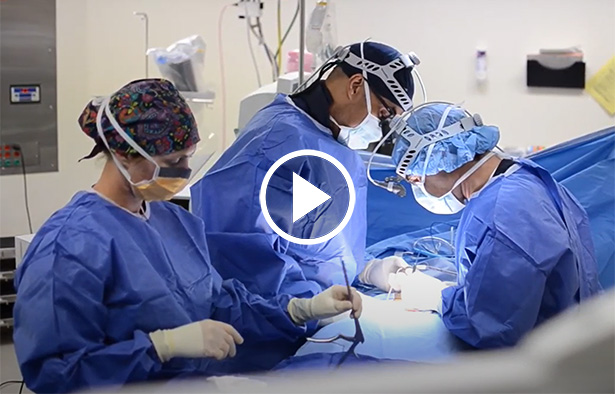
How Artificial Disk Replacement Works
In this video, you'll learn how artificial disk replacement works and why back pain sufferers have new hope for returning to the activities they love.
-
What Is Artificial Disc Replacement?
Simply stated, artificial disc replacement is a surgical procedure that involves removing a painful disc in the spine and replacing it with an artificial disc. This surgical innovation can be an excellent treatment for many patients suffering from chronic, severe low back, leg/arm pain and/or numbness and weakness caused by degenerative disc disease or a herniated disc.
Discs are the soft, fleshy parts that act as shock absorbers between the vertebrae (the bones of the spine) and allow a wide range of motion. As we age, these discs naturally degenerate, becoming dry and stiff. This doesn’t lead to pain or loss of mobility in everyone. But for some people, this degeneration causes pain in the lower back, sometimes radiating to the legs. In the cervical or neck region, disc degeneration may cause numbness and tingling in the arms, pain radiating down the arms, and even loss of motor function.
ADR surgery may be performed in the lower back (lumbar spine) or the neck (cervical spine) area. Artificial discs are designed to mimic the form and function of the spine's natural disc. The goal is to alleviate pain by removing the painful degenerated or herniated disc, stabilizing the spine, minimizing inflammation and allowing for a more natural motion in the spine.
Disc replacement surgery is performed using minimally invasive techniques, with the patient under general anesthesia. An incision is made in the front of the abdomen, or the neck, depending on the problem area. In most cases, the surgeon does not need to cut any muscles to access the area. The surgeon then removes the damaged disc and inserts the artificial disc. Disc replacement surgery usually takes one or two hours.
Each artificial disc is customized to the individual patient. The surgeon uses series of devices to measure and assess the size of the space between the affected vertebral bodies, to ensure the device is properly sized and fitted.
-
Who Is an Appropriate Candidate?
You may be a candidate for Artificial Disc Replacement if you have experienced any of the following:
- Neck pain with or without arm pain
- Lower back pain with or without leg pain
- Conservative treatment without significant relief of pain
- Degenerative disc disease
- Herniated cervical or lumbar discs
- Previous disc surgery with continued pain
- You have been advised to consider fusion surgery
-
Differences Between Spinal Fusion and Disc Replacement
Spinal fusion is a method used to treat back pain by removing the damaged spinal disc and fusing the remaining vertebrae together to prevent movement. Artificial disc replacement is used to treat similar conditions, but instead of fusing the bones, a spine surgeon implants a prosthetic device between them to preserve movement in the spinal segment. The primary difference between the two surgical methods is that disc replacement allows the patient to maintain movement, while spinal fusion does not. Research shows that patients with an artificial disc are 1/3 less chance of developing adjacent spinal segment disease as compared to fusion patients. ADR patients typically stay in the hospital for a shorter period of time and can return to activity sooner than fusion patients as well.
-
What Happens During Artificial Disc Replacement Surgery?
During disc replacement surgery, your surgeon will remove your problematic disc and insert an artificial disc implant into the disc space.
In cervical ADR surgery, the surgeon makes a small one- to two-inch incision on the side or front of your neck. The important structures of the neck are carefully moved to the side until the surgeon can see the front of the cervical spine. The affected disc is then removed and the artificial disc is inserted in its place. The procedure takes approximately 1-2 hours.
In lumbar ADR surgery, the surgeon makes an incision in the abdomen. The abdominal muscles are gently spread apart and the intestines and large blood vessels are moved to the side until the surgeon can see the front of the lumbar spine. The affected disc is then removed and the artificial disc is inserted in its place. The procedure takes approximately 2-3 hours.



Have Questions? Give Us a Call.
If you’ve decided that now is the time to explore surgery, call us to learn about the requirements and process for scheduling an appointment.
844-544-9501
-
Return to Work Faster
On average, many patients are able to go home from the hospital 1-2 days after surgery. Before discharge, therapists work with patients and instruct them on proper techniques of getting in and out of bed and walking independently. Patients may recover quickly and most return to work in 2-4 weeks after surgery. Patients can gradually begin to bend, twist and lift after 4-6 weeks as the pain subsides and the back muscles get stronger.
-
Greater Range of Motion
Unlike vertebrae that have been fused together, a spine repaired with Artificial Disc Replacement can move, bend, twist and turn with a natural range of motion.
-
Less Stress on Adjacent Disks
X-rays comparing Artificial Disc Replacement to lumbar fusion show that adjacent disc degeneration occurs approximately one third as often in patients who received Artificial Disc Replacement.
-
Less Likelihood for Future Surgery
Patients with cervical spinal fusion are 3 to 5 times more likely to have additional surgery than cervical Artificial Disc Replacement patients.