


7:30 a.m. – 4:30 p.m.
Sleep studies are typically performed overnight Monday to Saturday
from 7 p.m. – 6 a.m.
Understanding Childhood Sleep Disorders
-
When to Consider a Sleep Evaluation
A child suffering from a sleep disorder may exhibit one or more of these symptoms:
- Snores
- Makes other noises during sleep
- Is sleepier than expected during the daytime
- Has trouble falling asleep
- Has trouble staying asleep
- Has difficulty waking up in the morning despite sleeping adequate number of hours
- Wets the bed (past the age of 5 years)
- Has trouble falling asleep due to leg discomfort
- Sleepwalks excessively
- Has frequent sleep terrors
- Exhibits sudden behavioral problems at school or at home
- Shows signs of memory dysfunction or a lack of concentration
- Grinds teeth during sleep
- Moves excessively during sleep
- Has a craniofacial abnormality that may contribute to difficulty breathing during sleep
If your child is experiencing any of these issues, you should seek the advice of a trusted physician. If your child's primary physician recommends that your child be evaluated, a sleep specialist on the medical staff at Texas Health Center for Diagnostics & Surgery will be available for consultation. This is helpful for parents who are unsure whether their child's sleep patterns and habits are within normal range.
Studies have shown that sleep disturbance can be the cause of the above symptoms. Surprisingly, even simple snoring has been shown to decrease a child's performance and attentiveness at school. Not all children require a sleep study for care and not all disorders require medication. Even if you suspect that the problem is behavioral, you should speak with your child's physician to ensure proper evaluation.
-
Common Childhood Sleep Disorders
- Pediatric Insomnia
- Pediatric Parasomnias
- Pediatric Narcolepsy
- Pediatric Sleep Apnea
- Pediatric PLMS

Types of Sleep Evaluations & Therapies
-
Pediatric Sleep Study (Polysomnogram)
Sleep studies are painless and non-invasive, designed to monitor your child's sleeping cycle from brainwaves, breathing pattern, blood oxygen via pulse oxymetry, heart activity and body movements during an all night sleep period. The recorded patterns are then studied by a pediatric sleep physician on the hospital’s medical staff to accurately identify the different types of sleep disorders.
-
Pediatric CPAP/BIPAP Therapy
Continuous Positive Airway Pressure (CPAP) or Bi-Level Positive Airway Pressure (BIPAP) therapies are sometimes recommended after a patient has been diagnosed with sleep apnea. A mask is placed over the nose and/or face which helps prevent snoring and apnea (interrupted breathing) during the normal sleep period. Different levels of air pressure are gradually delivered to ensure airway patency and uninterrupted breathing during sleep. CPAP and BIPAP units help the patient maintain normal, continuous sleep.
Testing is necessary to determine the correct air pressure needed to keep the airways open. Consistent use of the CPAP or BiPAP machine is critical in the successful treatment of sleep apnea and thus practice with the mask may be necessary prior to coming into the sleep clinic for this study.
-
Pediatric MSLT
A Multiple Sleep Latency Test, or MSLT, is an assessment typically performed the day after the polysomnogram is administered. It is also useful in studying the severity of daytime sleepiness and can determine if narcolepsy is present.
Preparing for a Sleep Evaluation
-
Scheduling a Sleep Evaluation
A physician referral is required.
Sleep studies are performed Monday to Saturday from 7:00 p.m. – 6:00 a.m.
Daytime sleep studies or Multiple Sleep Latency Tests (MSLTs) are scheduled during the day.
Overnight studies typically begin at 7 p.m. and end by 6 a.m. the next morning.
The patient’s normal sleep routine will be considered during scheduling.
For questions and scheduling, please call 972-403-2878.
-
Before the Sleep Evaluation
- Patient should follow a normal sleep routine 48 hours prior to study.
- Patient should avoid caffeine for 48 hours prior to study.
- Patient and caregiver should eat dinner before arriving.
- Patient needs to continue regular medications as prescribed unless otherwise directed by patient’s physician.
- Patient should bring any overnight medications with him or her, in original bottles with labels.
- Patient should arrive bathed, with clean hair. Hair gels, sprays and other oily substances should not be used.
- Medications are not available and will not be administered by staff.
-
Accommodations
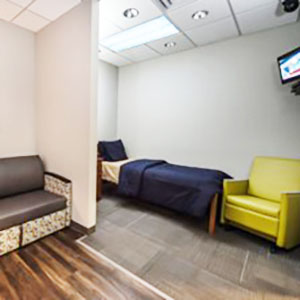 Our patient rooms are designed to make your child’s stay as comfortable as possible. Each room is decorated in a soothing color and a sleeping area for the parent/caregiver is provided. Additionally, every room is equipped with a television, WiFi and DVD players.
 -
What to Bring
- Parent or guardian, if patient is less than 18 years of age
- Insurance card, social security number, name and date of birth of insured
- 2-piece (loose and comfortable) cotton sleep-wear
- Socks or house shoes
- Overnight toiletries
- Change of clothes for the following morning
- A favorite pillow, blanket, or stuffed toy
- Favorite bed-time DVD (age-appropriate)
- CPAP/Bi-Pap mask and portable oxygen, if applicable
- For tracheostomy studies, please bring cap for trach
Medications are not available and will not be administered by staff.
-
During the Sleep Evaluation
At Texas Center for Surgery & Diagnostics, sleep technicians are trained to help children feel safe and secure. A technician will help your child prepare for the evaluation and will be available during the sleep period to monitor and make adjustments. The technician can also answer any questions the child or the parent/caregiver may have.
- We require one parent or guardian to stay with the child during evaluation.
- Your child’s sleep technician will confirm the patient’s medical history and ask you and your child questions about sleep symptoms, sleep behaviors and activities. The technician is also available to answer questions about the sleep study.
- There are five patient suites with different color and theme options. You and your child will be taken to your comfortable suite where you can begin your evening routine.
- After you’ve had a moment to get comfortable and your child’s sleep technician has completed the necessary paperwork, he or she will attach approximately 10 monitors to your child’s head, neck, chest and leg areas. Our technicians are experienced in placing these monitors on children of all ages and developmental backgrounds.
- The monitors are small, round and painless and should be easily removed after the study is complete. A belt will go around your child’s abdomen and chest, and a pulse oximeter will be placed around a finger (or foot) to monitor oxygen levels. Lastly, a nasal canula monitor will go under his/her nose to monitor nasal breathing. It is best to have a two piece garment, or button top for this portion of the study. The monitors will limit your child’s movements and activities that help him or her remain in bed are optimal at this time (books, videos, puzzle books, coloring books, for example).
- Lights will be dimmed by 10:00 p.m. in the child’s bedroom and by 10:30 p.m. in the rest of the suite.
- Your child’s sleep technician may adjust monitors or other equipment in your suite throughout the duration of the study.
- Your child’s sleep study should conclude near 5:30 – 6:00 a.m. The sleep technician will enter to remove all of the monitors. A brief discharge questionnaire regarding the study will be completed by the parent/caregiver before the patient leaves.
-
After the Sleep Evaluation
Your study will be reviewed and interpreted by a pediatric sleep physician on the hospital’s medical staff. The results will be sent to your referring physician within five to ten business days after completion of the study. Evaluation time may vary depending on the depth of the study requested by your physician.
To receive results, you should contact your doctor. If you have further questions regarding the study and its results, appointments are available with the sleep specialist on the medical staff at the hospital. Technicians are not authorized to discuss their observations regarding your child’s symptoms.